

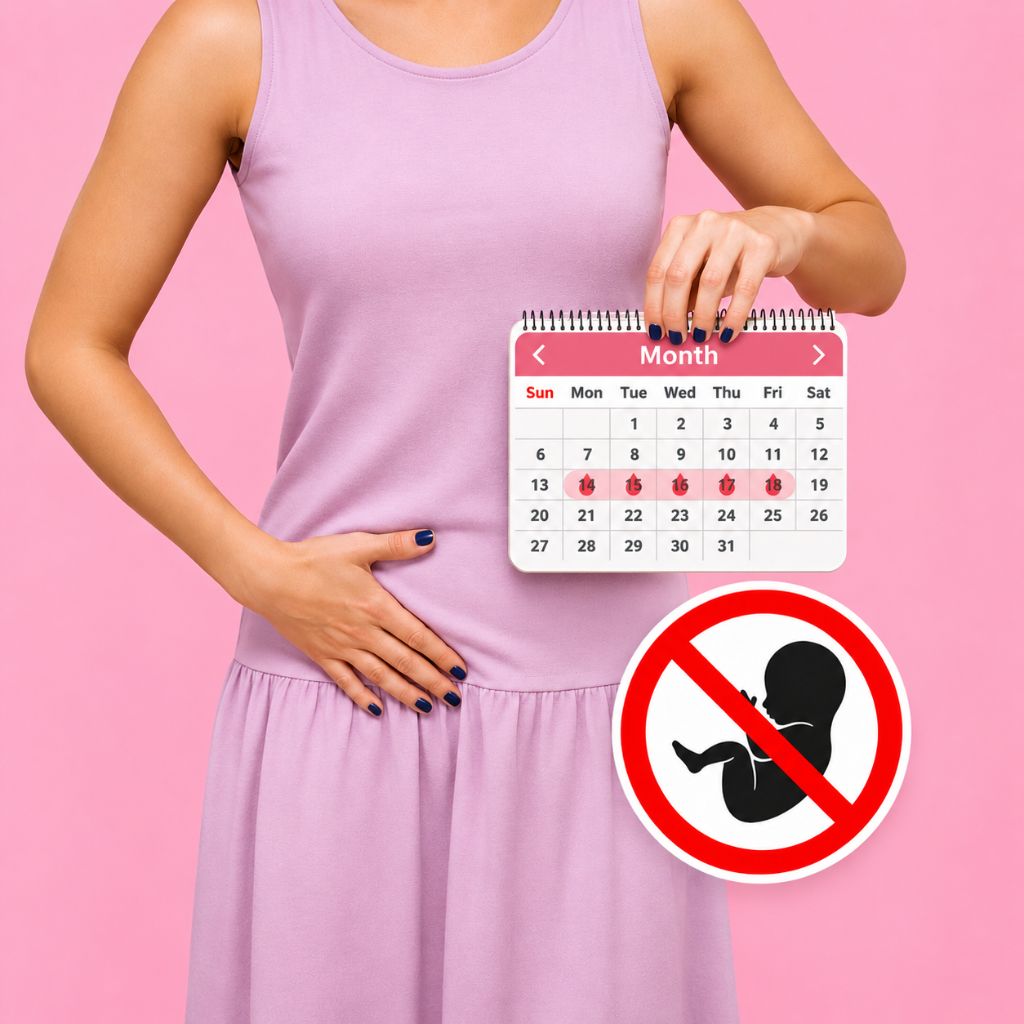
Yes, abortion can temporarily affect your periods. After an abortion, your body needs time to adjust to changes in pregnancy hormones and resume its menstrual cycle. Your first period may arrive earlier or later than expected, and you may notice changes in menstrual flow, cramps or the duration of bleeding.
Dr Shilpa Agarwal explains that understanding these changes can help women recognise what is generally expected during recovery and when medical advice may be needed.
How Does Abortion Affect Your Menstrual Cycle?
During pregnancy, hormonal changes prevent your usual menstrual cycle from continuing. After an abortion, pregnancy hormone levels begin to fall, allowing your body to gradually return to its usual hormonal pattern.
The abortion marks the beginning of a new cycle for practical menstrual tracking purposes. However, the timing of ovulation and the return of periods can vary from woman to woman.
This means your first period may not follow the same schedule or pattern as your previous menstrual cycles.
Why Is the Day of Abortion Considered Day 1?
For practical cycle tracking, the day a surgical abortion is performed or a medication abortion is completed is generally counted as Day 1 of a new cycle.
With a medication abortion, this refers to the completion of the abortion rather than simply taking the first medication.
However, this is a practical way to track recovery, not a guarantee of when ovulation will occur. Hormonal recovery varies, and ovulation can happen before your first period returns.
When Will Your Period Return After an Abortion?
Most women get their first menstrual period approximately 4 to 8 weeks after an abortion. However, the exact timing depends on individual hormonal recovery and other factors.
Ovulation may return within a few weeks, sometimes as early as 8 to 10 days after an abortion. This means pregnancy is possible before your first period.
If your period has not returned after 8 weeks, consider consulting a gynaecologist. A pregnancy test and medical assessment may be recommended depending on your circumstances.
What to Expect From Your First Period After Abortion
Your first period after an abortion may feel different from your usual menstrual cycle. Some women experience a heavier flow, while others notice lighter bleeding.
You may also experience changes in menstrual cramps, the duration of your period or the timing of your cycle.
These changes can occur as your hormone levels adjust. Your next few menstrual cycles may gradually become more familiar.
However, do not assume that every change is part of normal recovery. Persistent irregularities, severe pain or unusually heavy bleeding should be assessed by a medical professional.
Post-Abortion Bleeding vs Your Period
Bleeding after an abortion is a normal part of the recovery process, but it is not the same as your first menstrual period.
After a surgical abortion, bleeding may occur for several days or longer. Following a medication abortion, bleeding can be heavier initially and may continue as lighter spotting for some time.
Your first actual menstrual period generally returns several weeks later.
How to Tell the Difference Between Post-Abortion Bleeding and Your First Period?
| Post-abortion bleeding | First menstrual period |
| Usually begins around the time of the abortion | Generally returns 4 to 8 weeks later |
| Related to the abortion and uterine recovery | Part of the returning menstrual cycle |
| May include clots and cramping | May involve familiar or temporarily different period symptoms |
| Can continue as lighter spotting | Usually follows your menstrual bleeding pattern |
It is important to remember that bleeding patterns can overlap. You cannot always identify the cause of bleeding based on its appearance alone.
If you are unsure whether your bleeding is part of recovery or your menstrual cycle, a gynaecologist can help assess your symptoms.
When Should You Consult a Gynaecologist?
Although menstrual changes are common after an abortion, certain symptoms should not be ignored.
Seek medical attention if you experience very heavy bleeding, severe or worsening abdominal pain, fever, foul-smelling vaginal discharge, dizziness or fainting.
As a general warning sign, soaking two or more full-sized sanitary pads per hour for two consecutive hours requires urgent medical assessment. Do not delay seeking help if you feel faint or seriously unwell.
If your period has not returned after approximately 8 weeks, or you have concerns about a possible ongoing pregnancy, consult a gynaecologist.
Women seeking abortion-related care or guidance about menstrual changes can also approach Harley’s Women Clinic for appropriate medical consultation. Understanding the procedure, recovery process and possible changes in menstrual health is an important part of informed reproductive healthcare.
Dr Shilpa Agarwal can help women understand menstrual changes, assess recovery concerns and receive appropriate gynaecological guidance.
Frequently Asked Questions
Q1. Can you get pregnant before your first period after an abortion?
Answer: Yes. Ovulation can return before your first menstrual period. Therefore, pregnancy is possible even if menstruation has not resumed. If you do not wish to become pregnant, discuss suitable contraception with your healthcare professional.
Q2. Can an abortion cause a missed period?
Answer: Your period may take several weeks to return because your hormones need time to adjust. However, if menstruation has not resumed after approximately 8 weeks, consult a gynaecologist to check for possible causes.
Q3. Can a pregnancy test remain positive after an abortion?
Answer: Yes. Pregnancy hormone (hCG) can remain in your body for several weeks after an abortion, so a pregnancy test may continue to show a positive result temporarily. Follow the testing instructions provided by your healthcare professional. Persistent positive results or pregnancy symptoms need medical assessment.
Q4. Can abortion affect your ability to get pregnant in the future?
Answer: An uncomplicated abortion generally does not affect future fertility. Most women can become pregnant again after an abortion. However, complications such as an untreated infection may affect reproductive health and require medical attention.
Q5. What if my period has not returned after 8 weeks?
Answer: A delayed period may be related to hormonal changes, but other causes should also be considered. Consult a gynaecologist for an assessment, particularly if you have pregnancy symptoms or ongoing pain or bleeding.